Dinner Parties and Food Allergies: Whose Problem are They, Anyway?
I don’t want to attend a dinner where the host doesn’t concern herself with asking if I can get within a few feet of a peanut without dying when planning the meal.

Multiple articles dispensing advice on dealing with food allergies have circulated lately. As a person with this affliction — I was diagnosed with celiac disease over a decade ago — I found the responses disturbing.
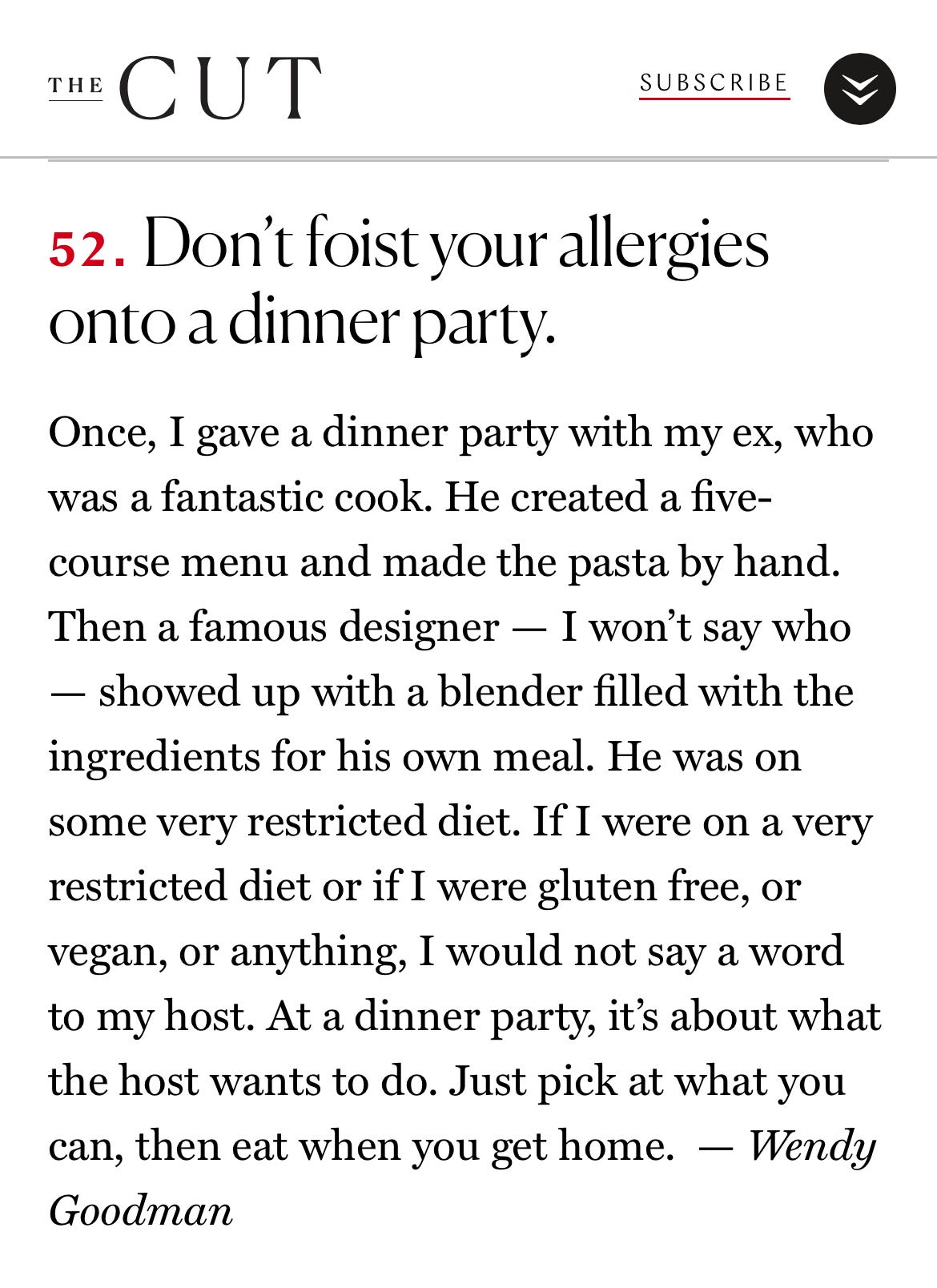
For the first piece of advice — featured in The Cut — the writer, Wendy Goodman, describes hosting a dinner party with her then-boyfriend. She was appalled when a guest arrived with their own food due to their dietary needs.
Goodman describes her boyfriend’s effort in preparing the meal, including making pasta from scratch for everyone to enjoy. How rude, Goodman scolds, to insult the host by not eating the food he lovingly prepared because it doesn’t conform to their diet.
As someone who has felt uncomfortable asking specific and somewhat intrusive questions about ingredients and food preparation methods, I understand entirely why the guest brought their own food to a party. It’s a nontraditional decision, but explaining precise dietary needs and how a host can meet them is challenging. Advocating for oneself is not for the faint of heart; it certainly doesn’t come naturally to most people.
Why, when inviting guests to eat food you’re preparing and serving ostensibly for them, do you not ask those same guests if they have dietary restrictions?
What Goodman advises is a recipe for disaster. Many people with food allergies carry EpiPens with them in case they go into anaphylaxis. I cannot imagine a bigger buzzkill at a dinner party than someone who didn’t mention an allergy out of politeness asphyxiating and dying at or near the dinner table.
I don’t want to attend a dinner where the host doesn’t concern herself with asking if I can get within a few feet of a peanut without dying when planning the meal.
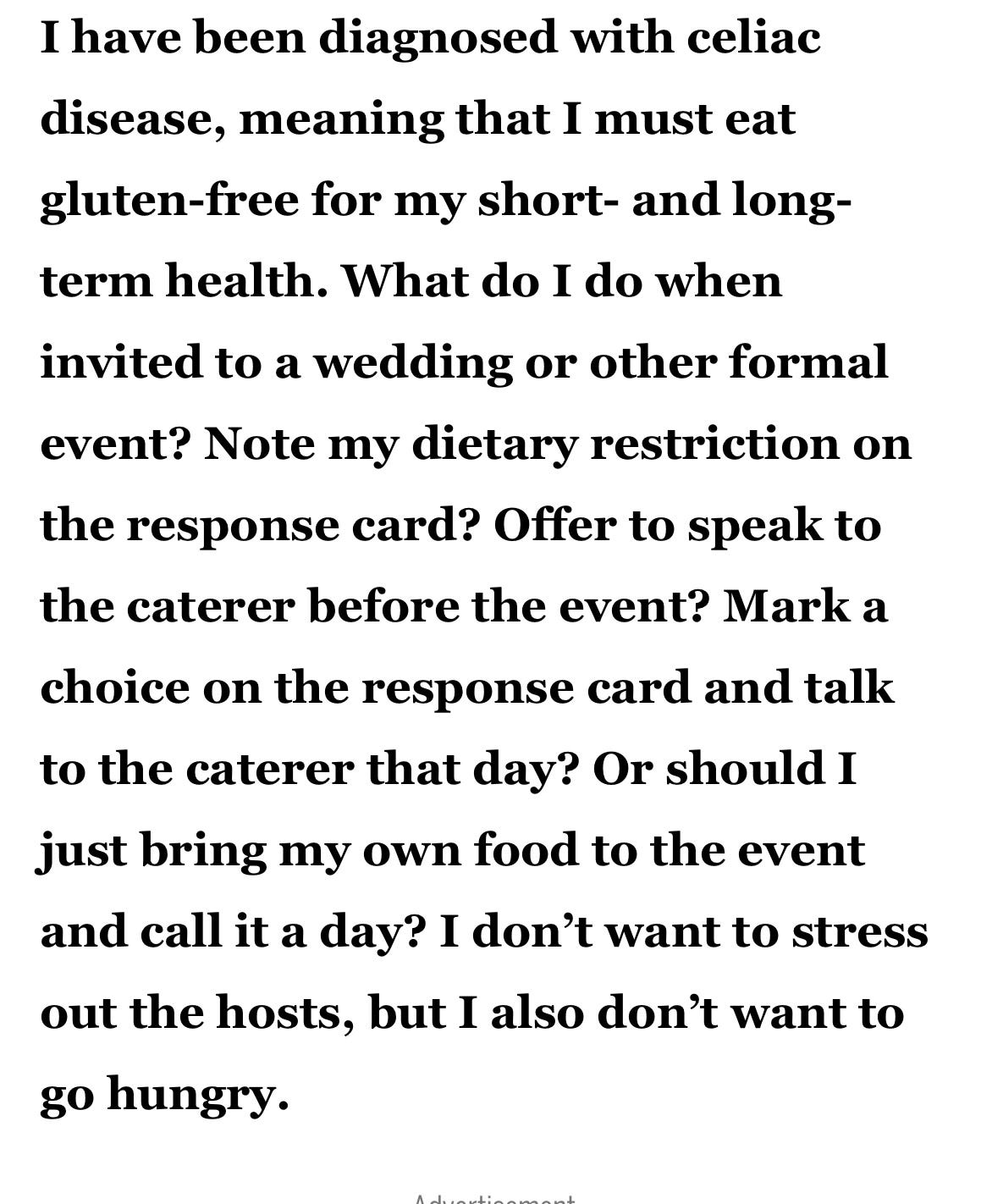
Miss Conduct wrote the second piece, which was featured in the Boston Globe. The advice seeker is a newly diagnosed celiac. Celiac disease is a gluten allergy — a protein found in wheat, barley, and rye. A slew of products scattered insidiously throughout the food supply are hidden sources of gluten.
The writer asked Miss Conduct how to deal with her diagnosis in formal and informal settings; Miss Conduct advised her to do the same thing that Goodman derided in The Cut. “The safest solution is to bring your own food,” Miss Conduct says authoritatively.
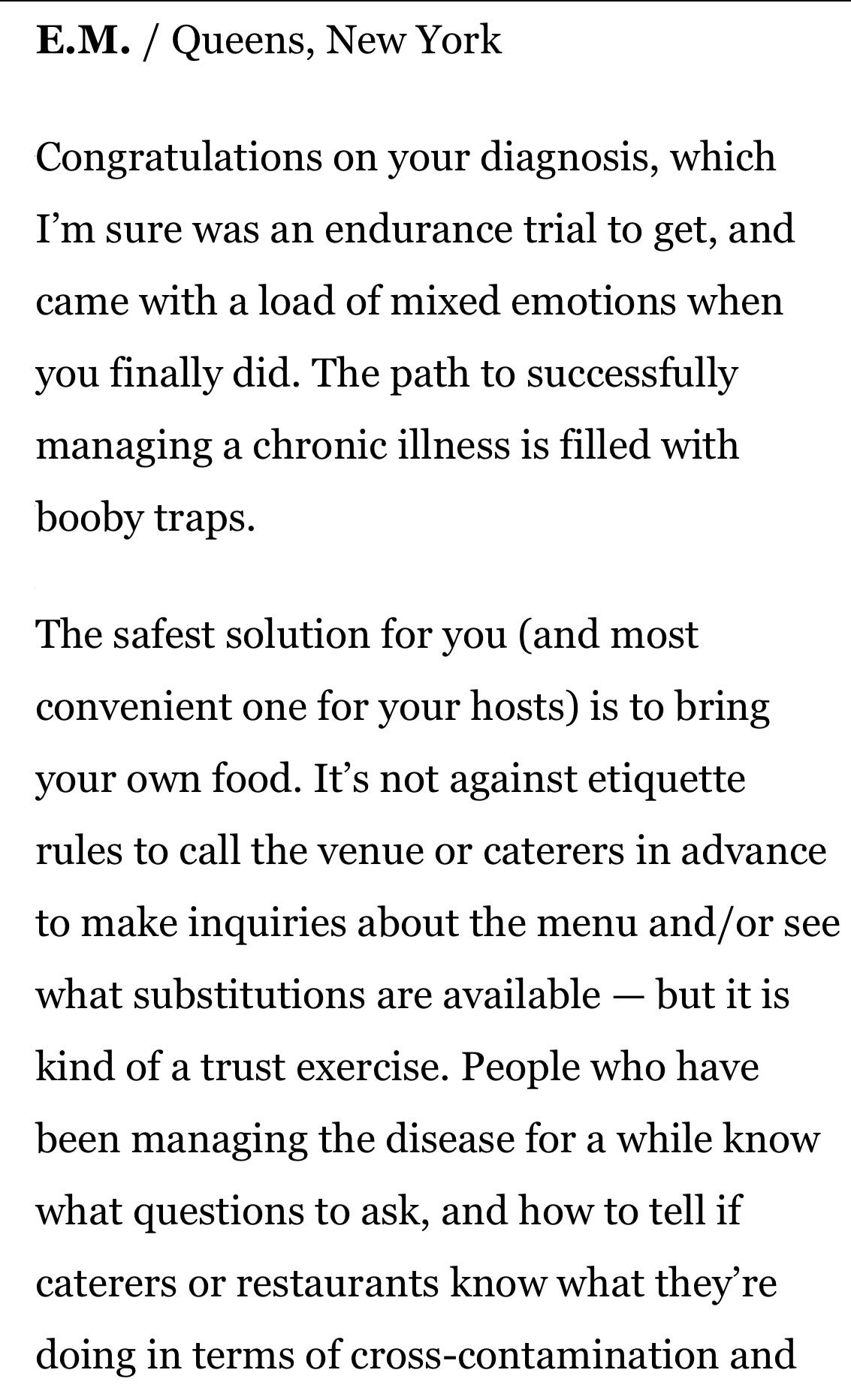
Miss Conduct’s advice to E.M. is thorough and mostly in line with my own experience. I appreciate how she describes consuming food you don’t prepare yourself as a “trust exercise.” This characterization is accurate for both restaurant-made meals and those served at parties thrown by loved ones.
Her suggestion to call an event venue and inquire about allergy-safe meals is questionable; often, a catering manager won’t agree to serve a special meal to a guest without discussing it with the people paying the bill — such as a couple that’s getting married. Party hosts may perceive making such an inquiry as going behind their back, even if you’re only trying to save them the hassle of dealing with your food allergy. A surcharge is likely involved for a meal with a dietary restriction, and the couple must agree to include that charge in their contract with the venue.
Talking to the caterer on the day of the party won’t work, as the kitchen must be made aware of meals with dietary restrictions well in advance of an event. Many formal venues won’t allow guests to bring their own food, either. The best move here is to be up front with the party host about your needs.
Advocating for oneself is not for the faint of heart; it certainly doesn’t come naturally to most people.
One of the most delightful dinner parties I’ve ever attended occurred not long after I got the official celiac diagnosis from undergoing an endoscopy. Other guests at the party had dietary issues ranging from severe (peanut allergy) and rare (fructose allergy) to preferences like vegetarians. It was an absolute delight for several reasons, chief among which was that the hosts asked detailed questions in advance to ensure that all of us would be safe based on the ingredients they used and the dishes they prepared.
Looking around the table at that party, I felt appreciated. I felt safe. I was with friends who showed, through their questions and meal prep, that they cared about me. I had found my people.
When I was first diagnosed and began eating a strictly gluten-free diet, I remember wondering what would happen to me if I came into contact with gluten. It’s a question many people ask me when they hear I have celiac disease. The answer is unpleasant.
After getting gluten-poisoned, the first thing I notice is internal heat. I get uncomfortably warm within an hour of ingesting some gluten, and often the initial response is to tie my hair back off my neck, so I cool down a bit. Then, with no other warning, I begin to vomit.
The puking lasts for hours and leaves me exhausted. I feel the side effects for days. My throat is raw, making it hard to eat, and I’m dehydrated from my system purging. There are also impacts on my excretory system, but let’s end the description here.
One pleasant October afternoon, my then-boyfriend and I went shopping for wedding rings in Boston. We stopped for a quick, early dinner before meeting his father and sister at a hockey game. It was my first time attending a matchup for the team where my now-husband’s family has season tickets. I was excited, from the ring shopping and talk of our future plus the chance to see the hockey team (a big part of my husband’s life) play for the first time in person.
I tied my hair back just a few minutes into the game’s first period. My feeling warm was unusual due to how cold the arena is kept to maintain the ice. Our seats were up some steep stairs, though, and we walked quickly to get to the top. I didn’t think much of it. Then, our team scored. I threw my arms over my head in celebration, screaming, and puked. Everywhere.
I ran down the steep steps twice as fast as I had climbed them, mortified by the trail of sickness I left in my wake. You can see me in television coverage of the event, racing out of the arena as the team and crowd celebrate.
Luckily a restroom is located close to where our section empties out onto the concourse. My sister-in-law found me there, slumped on the floor, and helped me clean up. It was Halloween, a big party night for the college students that attended our team’s games. I hoped the security staff knew I wasn’t an over-served coed. It was a severe allergic reaction — we had grabbed burritos from a local spot that claimed to make them gluten-free, but I ate something that was contaminated.
My then-boyfriend took me straight back to his house and put me to bed with a ginger ale on the nightstand. He cleaned up my boots and the clothes I was wearing when I got sick. It took a few days for me to fully recover, a pattern to which I’ve since grown accustomed.
The part of Wendy Goodman’s piece that bothers me the most is this: “At the dinner party it’s about what the host wants to do.” Respectfully, what kind of monster throws a party with that attitude? I don’t want to attend a dinner where the host doesn’t concern herself with asking if I can get within a few feet of a peanut without dying when planning the meal.
A few months ago, I had to attend a family event that required significant travel. While my husband and I were making plans, I texted my parents about the food preparations for the event. My mother is also celiac, which she discovered a few years after my diagnosis. She said the family ordered big party-style sandwiches from a caterer, so she wasn’t sure what we would eat or if we would “just skip eating.”
Something about being told by your mother to skip eating for the sake of simplifying a mandatory family gathering makes your heart break a little bit.
Food allergies aren’t an inconvenience. They’re a medical condition. Nobody chooses to have one; they’re immutable characteristics. Approximately 4% of adults have a food allergy (different from an intolerance). Next time you consider hosting an event, I hope you think of what I’ve shared today. Show your friends and family that you love them by asking if anyone has an allergy, and don’t be rude about accommodating people with dietary restrictions. Remember: it’s a trust exercise.